The National Register of Historic Places reached 100,000 listings on May 9. According to the Arkansas Historic Preservation Program, nine recent additions to that long list are here in the Natural State.
“Listing these properties on the National Register of Historic Places is a true distinction, and it illustrates the special places that exist all across Arkansas,” said Ralph Wilcox, national register and survey coordinator and deputy state historic preservation officer for the Arkansas Historic Preservation Program. “This group of properties is very diverse, which shows the multi-faceted history of the state.”
The nine sites added in May 2025 are the following:
Big Spring in the Bull Shoals vicinity is located in Shoals-White River State Park and was built as part of the Green Thumb Program circa 1973.

Big Spring – Image courtesy of Arkansas State Historic Preservation Office, photograph by Ralph S. Wilcox, 2024
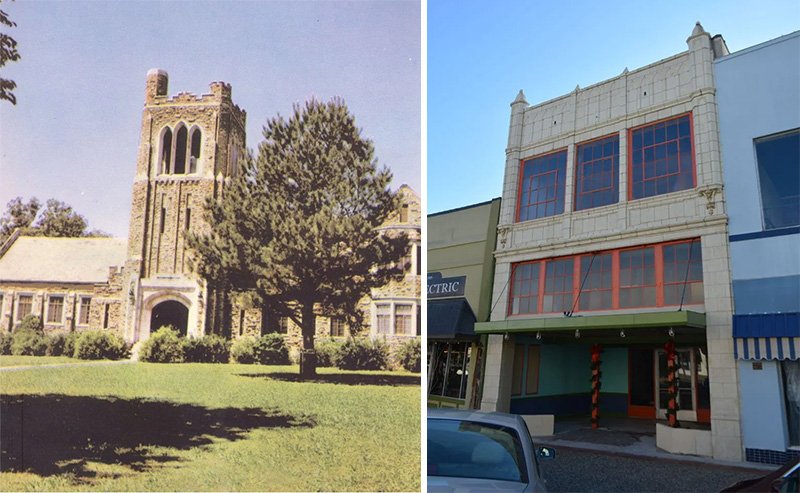
The Fine Arts Building at the University of Arkansas at Monticello (as seen on left side of feature image) in Drew County was designed by architect A.N. McAninch. It was built in 1934-1935 with help from the Public Works Administration.
The Smith Creek Bridge in the Webb City vicinity of Franklin County was a bridge built in 1941 by the Works Progress Administration.

Smith Creek Bridge, Courtesy of Arkansas Heritage
The Porter-McClure Paint Company Store (as seen on right side of feature image) in Texarkana was originally built in 1886 and later modified circa 1953. Its terracotta exterior is a significant example of the building material’s use in Texarkana’s Late Gothic Revival style.
The Gibson & Company’s Blue Star/Horizon Home in Little Rock was designed in the Wrightian Style by architect F. Eugene Withrow and built in 1964. The house was an award-winning design in the Horizon Homes program, which encouraged the use of concrete in constructing homes.

The Gibson & Company’s Blue Star/Horizon Home, Courtesy of Arkansas Heritage
The Robert H. and Martha Johnson House in Little Rock was built from 1926 to 1927 and designed by architect H. Ray Burcks. The home is an example of the Tudor Revival style, which became popular after World War I.

The Robert H. and Martha Johnson House, Courtesy of Arkansas Heritage
The James Johnson Boys Club Building in El Dorado was built from 1961 to 1963 and designed by architect John B. Abbot to provide a Boys Club facility for El Dorado’s Black community.

The James Johnson Boys Club Building, Courtesy of Arkansas Heritage
The William and Marion Orton House in Fayetteville is an example of the Organic style of architecture that Fay Jones was known for. It was completed in 1959.

The William and Marion Orton House, Courtesy of Arkansas Heritage
The Rose Hill Cemetery in Harrison, established in 1878, contains 1,000 burials and the graves of many prominent Harrison and Boone County figures.

Rose Hill Cemetery, Courtesy of Arkansas Heritage
For more information about the National Register of Historic Places, click here.
Feature Photo: Fine Arts Building at the University of Arkansas at Monticello | Credit: Encyclopedia of Arkansas (left), Porter-McClure Paint Company Store | Courtesy of Arkansas Heritage (right)
READ ALSO: New Discount Tire Location to Open in West Little Rock